
Life in Kinetics
Ausdrucksformen nicht-menschlicher Entitäten
Forms of expression of non-human entities
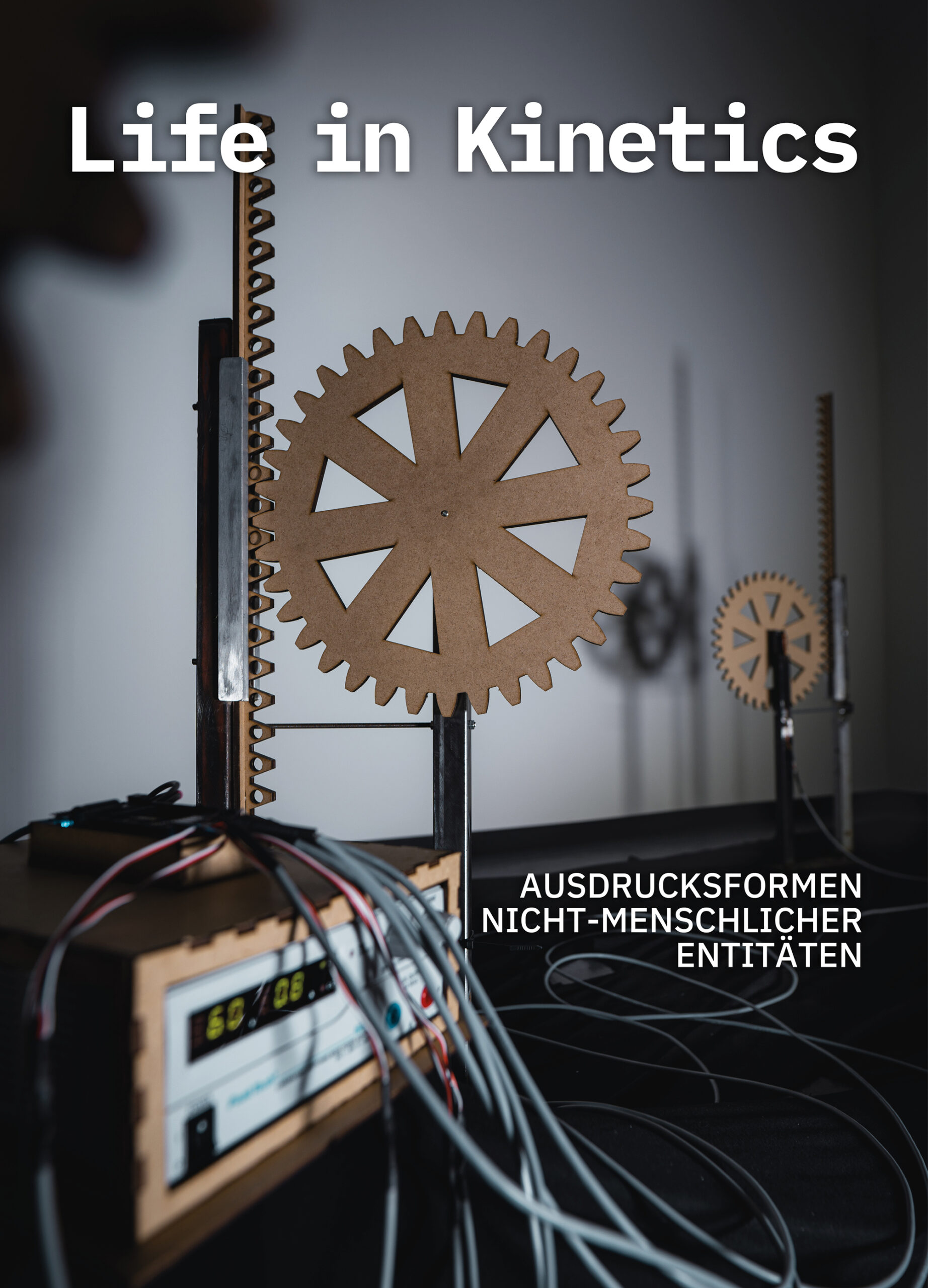
„Life in Kinetics“ consists of ten machines performing a simple up-and-down motion. Distributed throughout the space, they form an interactive, collectively responsive system. As soon as visitors enter, the machines alter their movement patterns and respond to proximity and position—sometimes individually, sometimes together—thus creating a direct interaction between human and machine.
STEEL | MDF | SERVOMOTORS | CAMERA VISION
Description
Life in Kinetics is a kinetic installation in which machines respond to the presence of visitors with simple vertical movements.
Distributed throughout the space, they form an interactive, collectively responsive system. The deliberately open presentation of the technology makes the processes comprehensible: gears, linkages, cables, and servomotors are visible, while a central power supply unit provides energy to all machines. From there, all cables run openly to the apparatuses, making their functioning immediately apparent.
A depth camera continuously captures the positions of people in the room and translates this movement data in real time into the behavior of the machines. The result is a precise yet minimalist choreography: at times individual, at times collective, at times seemingly wilful. Despite their simplicity, the machines develop an unexpected expressive quality. Their movements make them appear attentive, almost animated, and open up an experiential space in which interaction and resonance between human and machine become directly perceptible.
Condition I
In this mode, all devices move in a continuous, organic base rhythm. When a person enters the tracking area, their position directly controls one of the devices, while the others keep their base movement. Multiple people can each take over one device at the same time, making the overall motion shift from autonomous behavior to a shared, bodily choreography.
Condition II
In this mode, all devices first move in the same lively base rhythm as before. When a person is detected, all devices retreat to a neutral position – except one. This single device “steps forward” and follows the person’s position, while additional visitors each trigger another device, turning the scene into several parallel one‑to‑one interactions.
Condition III
In this mode, the devices move in a calm base rhythm as long as nobody looks at them. The moment someone directs their gaze towards the installation, all devices freeze in place. By simply looking away or briefly covering their eyes, visitors can let the movement resume.
Condition IV
In this mode, all devices react as a single group. When a person is detected, every device stops its movement, then aligns with the person’s position and follows them in synchrony. The whole installation seems to turn its shared attention toward one body.